
Meet the Team that Makes it Happen
We talked with our four coordinators about their essential roles in keeping CAW running smoothly, the art that they make, the pets they call family, and what they do in their free time.
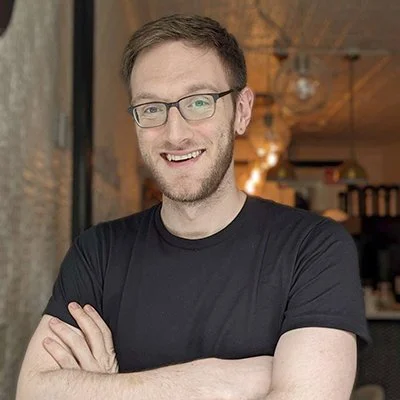
EJ Mehan
EJ Mehan
Finance and Administration Coordinator
Claim to Fame: Digitized summer youth apprentice (YA) payroll, saving hours of hand-processing time and vastly reducing errors.
EJ Meehan has been with CAW since March 30th, 2026. He supports all administrative and financial functions alongside the Director of Finance and Administration, overseeing payroll, HR compliance, and general operational needs to ensure the organization runs smoothly. A puzzle aficionado, EJ enjoys the problem-solving aspect of his job – for him, the challenges are the most rewarding part.
Outside of work, EJ is the team captain of his volleyball team, and has recently taken up crocheting. A graduate of the NYU theater program, EJ is a produced playwright. He continues to write fiction, and is working on a sci-fi fantasy trilogy. He shares his apartment with his cat, Thomas, an 18-pound gray tabby known for his loyalty and persistent affection.
CAW: What is something you like about working at CAW?
EJ: I like everyone that works here and getting to meet everyone has been very lovely. Everyone is very good at what they do. I appreciate that it's a very relaxed and creative workspace. It's not a corporate, buttoned-up kind of environment, which I think is fun.
CAW: Describe your typical day or week on the job.
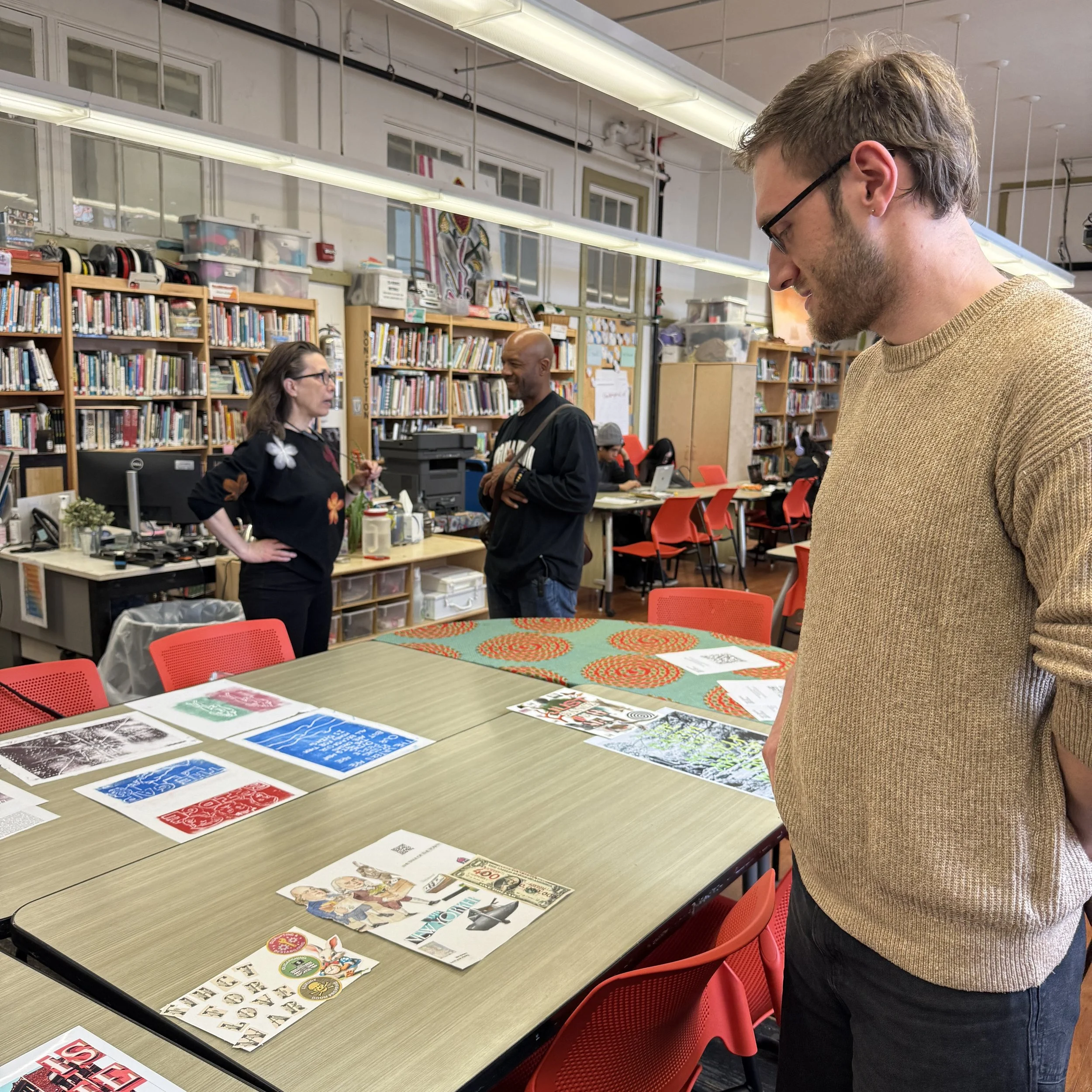
EJ at at middle school gallery walk
EJ: One of the things I have been enjoying a lot about the job is that there isn't necessarily that much of a typical week. Every week has been very different in its own way. For instance, this week I'm focused on setting up the staff retreat. So there's all the logistics of that, getting a space, getting catering, making our schedule and making sure we have all the materials. But in another week, I’ll be doing something completely different.
CAW: What are the most rewarding aspects of your job and what are the most challenging?
EJ: I love problem solving. Digitizing the time cards for our summer youth apprentices was a lot of fun for me to figure out because it took a lot of research and figuring out how to overcome all the roadblocks that popped up, and then adjusting it once it was deployed in the field. I'm a big puzzle guy, so I like having puzzles in my work as well.
CAW: What makes you the right fit for this job?
EJ: Ian and I work very well together, which I think obviously helps. I think I'm operationally minded. In my normal life as well as all of my professional life, I'm constantly trying to identify where there is friction and how can I reduce that? I’m always looking for ways to remove obstacles so that we can be the most efficient organization so that more of our time, money, and resources can go towards the mission.
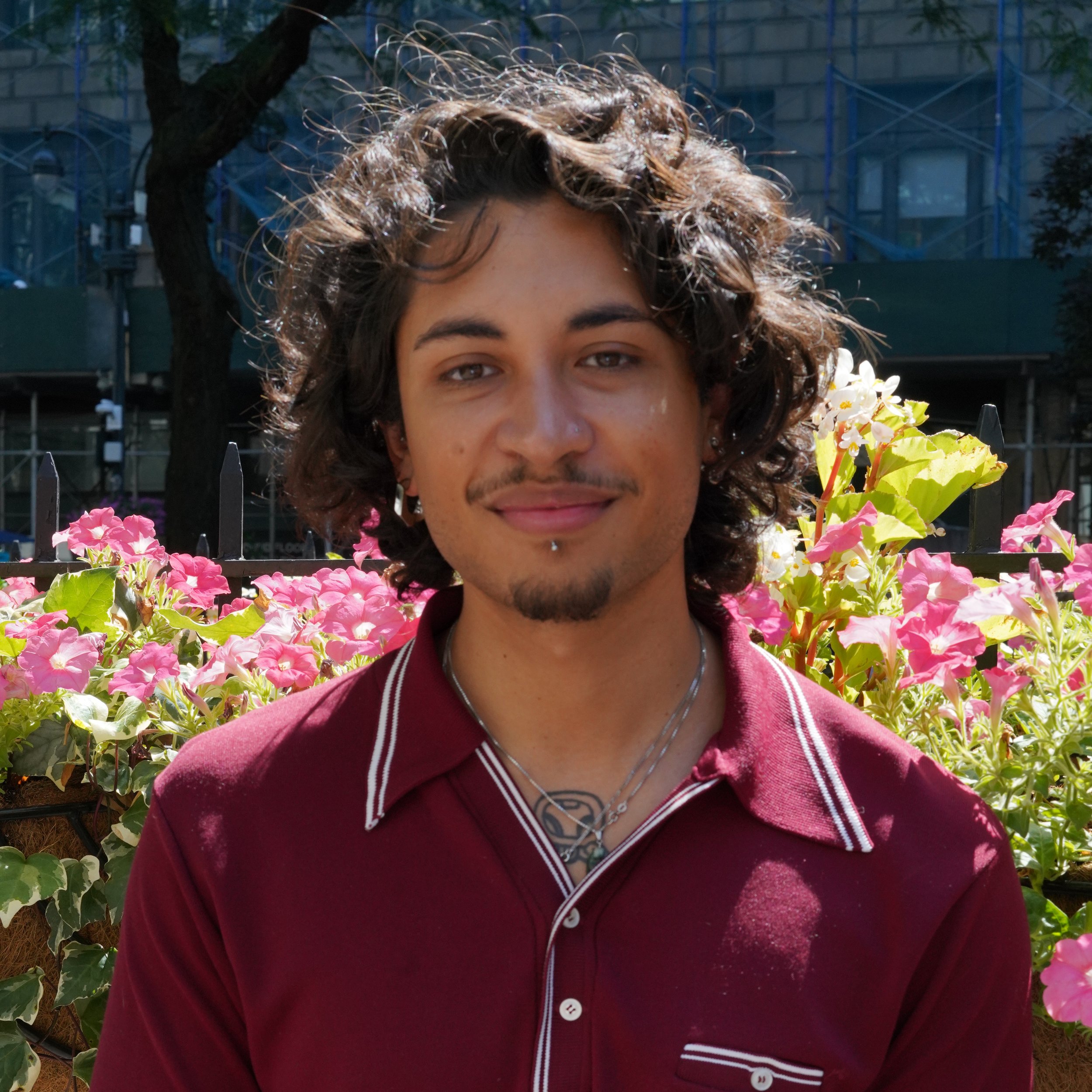
Emilio Vides-Curnen
Emilio Vides-Curnen
Operations Coordinator
Claim to Fame: Completely reimagined inventory storage and delivery processes, saving countless hours of time while reducing waste and stress.
Emilio describes their position as supporting all foundational program work by supplying materials to CAW programs across four boroughs, including procurement, delivery, and inventory. He serves as a direct assistant to program managers and teaching artists (TAs). In addition to day-to-day logistics, Emilio plays a central role in planning the Annual Benefit, overseeing the venue layout and run of show to ensure all logistical details are coordinated among staff, vendors, and the venue.
In their free time, Emilio sews, attends live music, and spends time socializing his kitten, Miu Miu. They hold a double major in fine art and architectural studies from Brown University. Emilio continues to make drawings of “plants, animals and microscopic things” that explore themes of sustainability and humanity's relationship to the natural world. They recently returned from a trip to the Grand Canyon and Yosemite National Parks. They said all their walking in the city didn’t prepare them for the challenge of five-hour hikes – “My feet hurt for days afterwards.”
CAW: Were you always an organized person? Did you have to learn how to do this or is this something that just comes naturally to you?
Emilio: You mean, did I go to organizing school?
CAW: Well, yeah, it does seem like you have a Ph.D. in organization.
Emilio: I've had systems in my life that have made sense to me. I think what has happened throughout this job and previous jobs is I've learned how to make systems that make sense to other people. I personally work off of memory recall and I have really good spatial awareness, so I know where things are based on where I put them, but that obviously doesn't work for the majority of people. For instance, my initial plan was to organize the supply room based on categories – all the pens and pencils go here, all the paper goes here, but I realized through talking to Ricky and Maddie, who are the people who use the supply room the most, that's not actually how teaching artists think about their work. They're not thinking about organizing things alphabetically or by color codes. They're thinking “What do I need in order to do a printmaking class?” “What do I need in order to do a collage project?” So it's much more efficient for them to have the supplies organized by project type. And it's not set in stone. It very much is adaptable to the needs of the season. It's definitely a living, breathing thing.
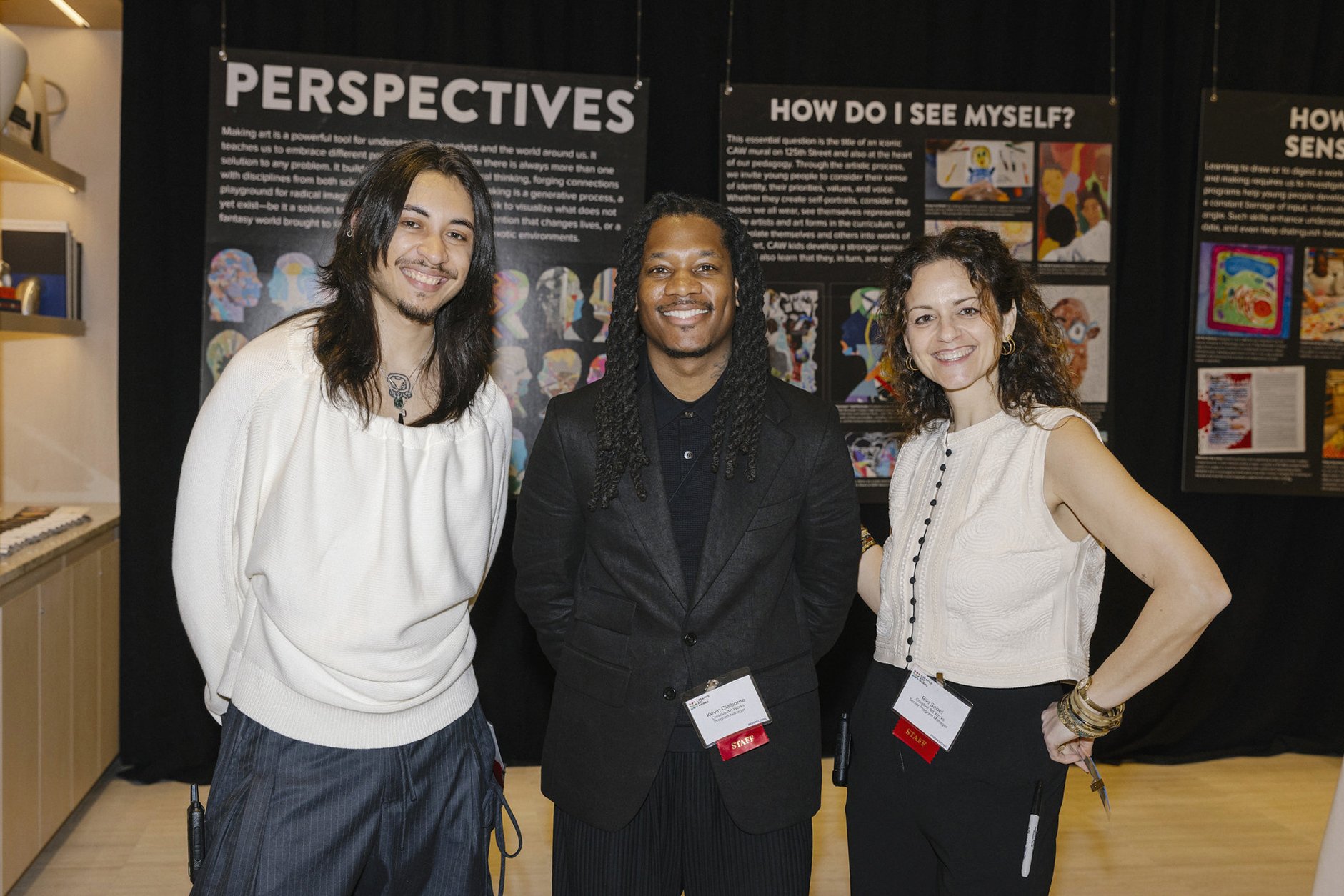
Emilio, seen here with CAW Program Manager Kevin Claiborne and CAW Program Manager of Teaching & Learning Ricki Sabel, brought his flair for organization to the layout and run of show for the 2026 Annual Benefit for Kids
CAW: Describe a typical day for you.
Emilio: It really depends on the time of year. A typical day during the school year involves monitoring curriculum in order to anticipate when it’s time to order and deliver supplies, and coordinating closely with TAs to avoid any surprises. There's always multiple programs happening at the same time, so it's a lot of juggling, prioritizing, and coordinating.
CAW: How is the summer different from the school year?
Emilio: Summer is the largest lift of the year in terms of program materials. You have to guesstimate how many things will be needed at each site months in advance and then order accordingly, whether it's through sourcing donations or ordering them directly. Then it's a question of making sure everything gets to the sites. That is a big effort because it's six sites across the city and it all has to go out on the same day. During the summer, everyone’s so busy and it's such a fast pace, so it's a lot of thinking on your feet. I love everything about it except for the heat.
CAW: What’s the biggest impact your work has on the organization?
Emilio: I feel like we've gotten to the point now where certain things are so routine that it allows us to spend time on more important things, which I take that as the ultimate compliment. We're not worried about all the logistics leading up to summer because there's already a system. We just look at what we did last year and basically copy and paste it and make tweaks.

Paola Gonzalez
Paola Gonzalez
Development and Communications Coordinator
Claim to Fame: Streamlining CRM system, refreshing CAW’s Social Media
Paola’s role bridges two distinct functions: development – raising funds to continue our mission – and communications – telling our followers and the general public about the impact our good work has on NYC young people and their communities. Her responsibilities can shift from crunching numbers or grooming the mailing list to writing blogs or laying out brochures. Paola has been fearless about learning our Constituent Resource Management system, which is a monster of a program, and identifying ways we could make better use of this powerful tool.
Paola recently relocated from Fort Lee, New Jersey, to Mott Haven in The Bronx with her boyfriend, her dog, and her cat. (Things are still in boxes.) Paola, who holds a bachelor's degree in psychology with a minor in women's studies and studio arts from Lehman College, pursues a wide range of creative hobbies including crocheting, needlepoint, painting, and photography. She credits a lifelong inclination toward creativity as having naturally led her to her current role with CAW.
CAW: What’s your typical day like?
Paola: Every day can be different depending on the season. There are some days where I'm crunching numbers and doing a lot of development work, for example during our annual appeal or annual benefit. During the summer or the school year, when a lot of programs are happening, that's when the job becomes more creative, because I'm creating material to showcase the programs or recruiting flyers to encourage students to sign up, or writing blogs. So there's a difference between numbers and creativity between my job. I'm constantly switching between the two.
CAW: At CAW, we like to say that every job requires creativity. How does creativity help you on the development side?
Paola: I think the two sides of my job go hand in hand, because the writing I do on the communications side helps me write better on the development side and vice versa. You really have to know the programs well enough to talk about them, whether you are reporting on the use of funds for a grantor or writing a blog that’s going to be read by our donors and supporters. Even if you're making an Excel sheet, you can make it look very basic, but sometimes you have to be very creative in how you present things to people.
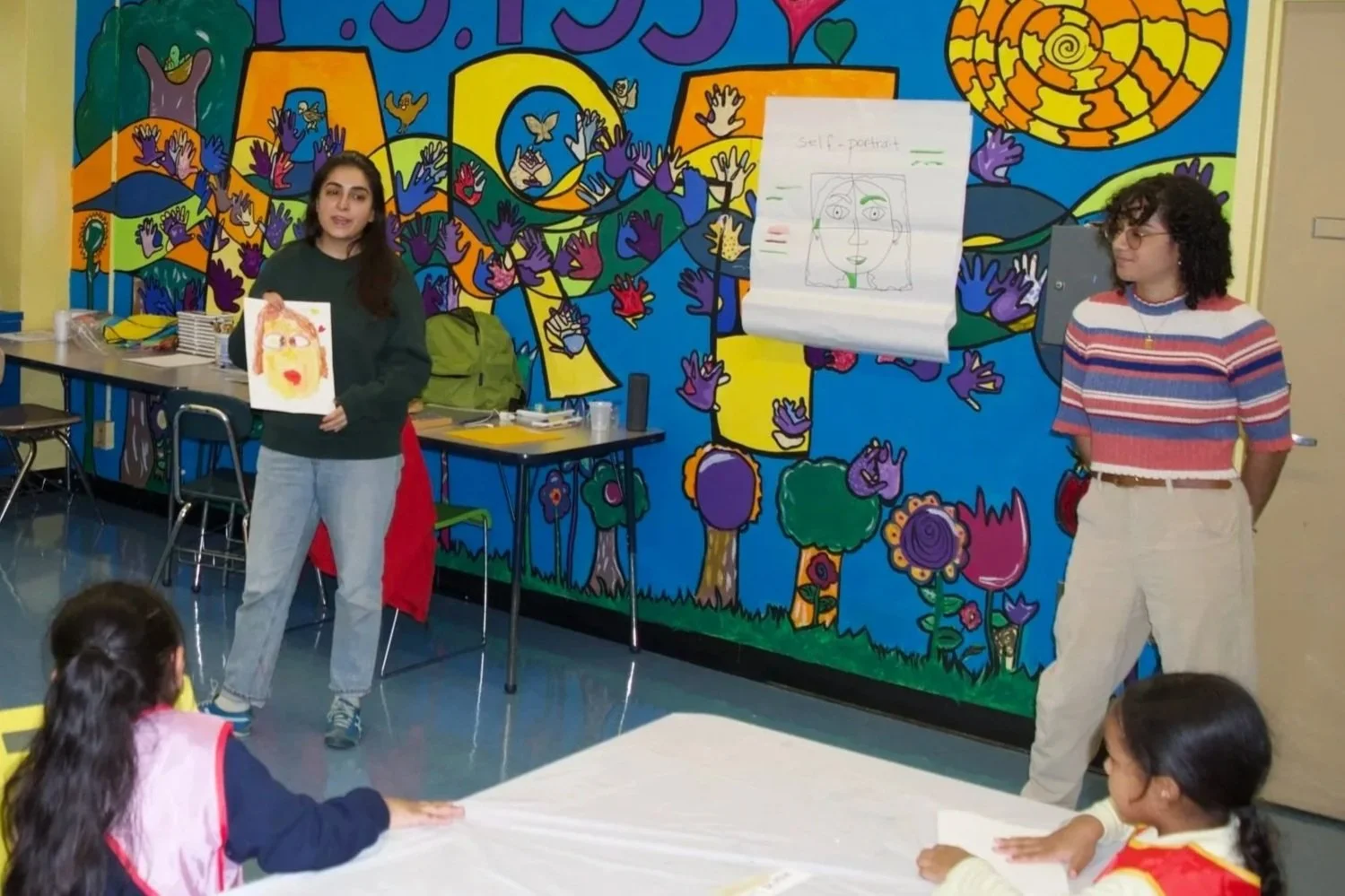
Paola Observing a class at PS 153, The Adam Clayton Powell, Jr. School, in Harlem - the same school she herself attended as a child
CAW: You have recently been handed the job of overseeing our social media. What do you see as some of the challenges there and what are some of the opportunities?
Paola: I think I'll start with the challenge: There's a big difference between handling social media as an organization as opposed to posting on your personal account just for fun. When posting as CAW, I have to be a lot more intentional and use the institutional voice. What I like is that I’m in charge of the content and I do have a little bit of freedom when it comes to choosing the direction and the execution.
CAW: What are we trying to say in our social media?
Paola: I think we're trying to say that creativity isn't confined to the classroom. It shows up everywhere and it's fundamental. You use creativity when you go to work, in your daily life, as a way to relax for your mental health. You never stop being creative, which is why I really liked that we held a community event at Dyckman Senior Center and invited kids from PS/MS 278 across the street to join us. It was great to see grade-school students making art alongside community elders.
CAW: What is something that you've done as part of your job that you are really proud of?
Paola: I'm really proud of seeing the marketing material I make out in the world. Every time I go to an event and I see people reading a flyer or a brochure that I made, I think, "Oh my God, I made that!"

Madeline De León
Madeline De León
Programs Coordinator
Claim to Fame: Digitizing and analyzing months' worth of programmatic data to measure impact; a 10-year connection with CAW; climbing the ranks from youth apprentice to Program Coordinator and Community Events Organizer.
Madeline, or as she's best known: Maddie, has a long history with Creative Art Works. She first joined CAW as a youth apprentice in 2016, working on “The More You Give, The More Your Grow,” [https://issuu.com/caw4kids/docs/2016_hamilton_grange_middle_school_/11] our third mural at Jacob Schiff School Campus in West Harlem. By her own account, she was so shy she didn’t want to talk to anyone that first summer; but by 2017, she had found her voice and was a standout working on a series of paintings commissioned by RBC. [https://issuu.com/caw4kids/docs/2018_rbc_issuu] She worked her way up to Teaching Artist Assistant in 2019, became Program Associate in 2022, then Program Coordinator in the fall of 2024.
Maddie discovered heavy metal at a young age, in part by staying up past her bedtime to watch Metalocalypse on Cartoon Network’s Adult Swim. By the age of 14, she was the vocalist in two metal bands. Recently, she has picked up the bass again and taught herself piano in order to better understand music theory. Her next goal is to learn a digital audio workspace with an eye towards becoming a music producer.
CAW: You've been with us since 2016. I don't remember you from your first summer at Jacob Schiff School Campus, but I definitely remember you from your second summer at the Winter Garden. You immediately stood out, and I think other people noticed you as well.
Maddie as a first-time youth apprentice at the unveiling of “The More You Give the More You Grow” at Jacob Schiff School Campus in West Harlem in 2016
Maddie: My first summer of 2016, I was so shy I didn't want to speak to anyone. I was very much under the radar. I know I had my moments where I did shine, and I remember my evaluations were all five out of five across the board, but I wasn't nearly as outgoing or as vocal as I am now. And that took years of personal development, on top of being in such a supportive environment where I was able to grow. So by the summer of 2018, which was my last year as a youth apprentice, I was already feeling much more confident. I began to put myself more out there and help other YAs, and take more initiative.
CAW: What do you think you got out of being a CAW youth apprentice?
Maddie: Where do I even begin? I'm so fond of my time as a youth apprentice. I was lucky to be surrounded by supportive teaching artists and the CAW staff. I had a safety net so if I failed, it was okay because it was an opportunity for me to grow. That support continued even when I became a Program Associate and then Program Coordinator. It definitely gave me so much more confidence in myself, whether it was about my art skills or opening my eyes to bigger opportunities. As a teenager, I had a very limited view of my capabilities. It's a testament to how much other people believed in me that I now feel like I'm going to continue doing bigger and better things going forward.
CAW: How would you sum up your position in a few sentences?
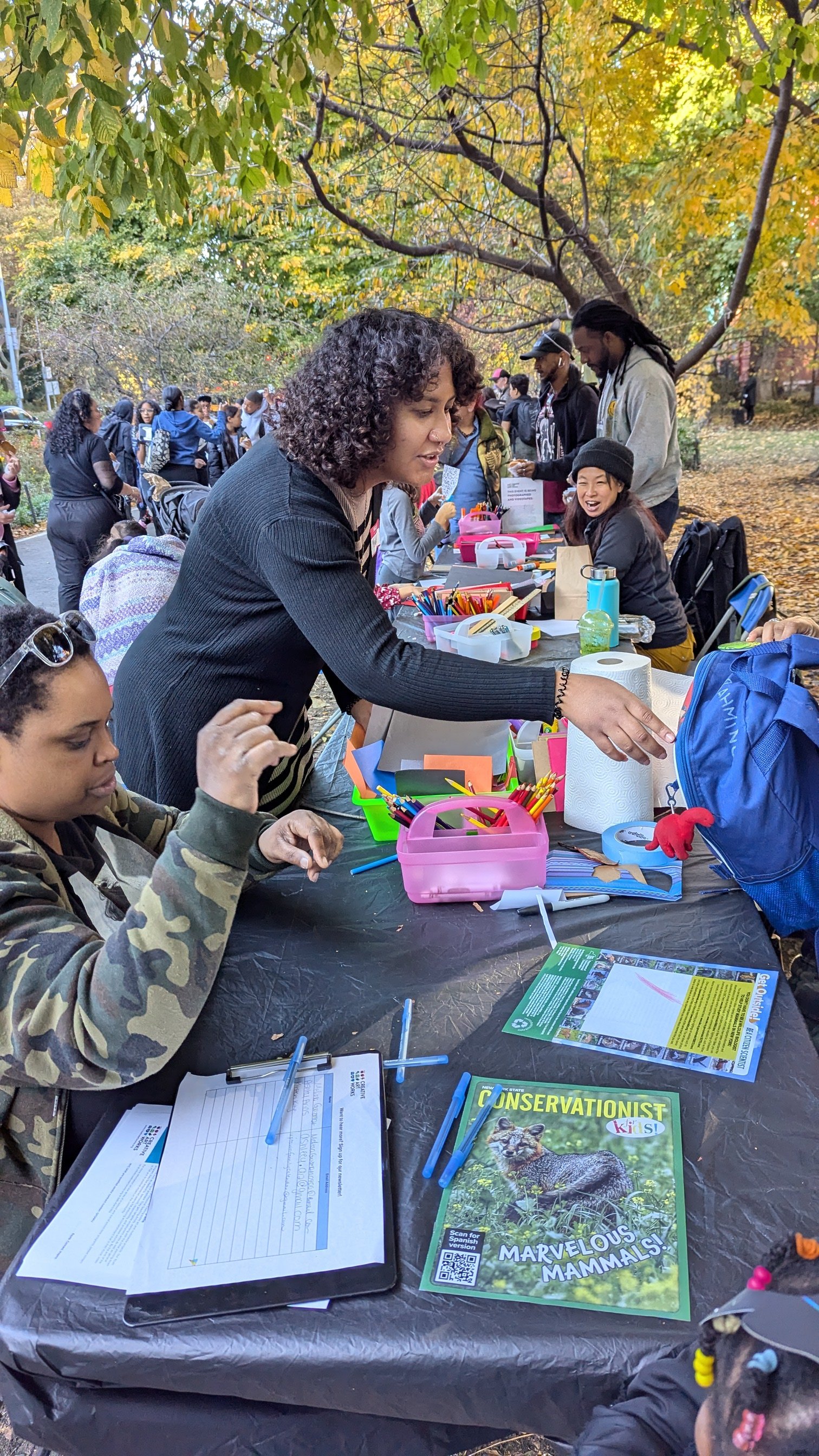
Maddie teaching at a community artmaking event last fall
Maddie: That’s tough, because I wear a lot of different hats. It's making sure that we're getting all of our compliance documentation in on time. It's analyzing our survey data and reviewing all our assessment tools to see where we're flourishing, where we're not doing so well, and how we can implement changes to make our teaching better. It's also subbing for our teaching artists. It's also supporting program management and logistics, making sure that our programs are running effectively. I’m also in charge of planning and implementing community events. It's also schlepping materials throughout New York City.
CAW: And you left out data analysis. You’ve become a wizard with spreadsheets.
Maddie: Oh, gosh! People underestimate how much time that takes. But there's a lot of different stories that you can come up with just by looking at data.
CAW: So part of your current role includes occasional substitute teaching or being a Teaching Artist Assistant. What's it like being on the other side of the equation?
Maddie: It definitely keeps me on my toes. Trends change. What was relevant even a couple of years ago isn't necessarily relevant now, right? We have to be adaptable. For me, teaching is like stopping to smell the roses, especially during our culminating events, which is what we drive towards in all of our curriculum. It's not just about mounting an exhibition. It's about seeing how much you have changed from point A to point B. The fact that our students are able to reflect on how much they have learned is already such high intelligence. I've also seen my fair share of difficulties with students but working through those challenges has felt the most rewarding.
CAW: One thing we have noticed about you is that, in a very positive way, you push your students to do things for themselves.
Maddie: It's more like a gentle nudge in the right direction. I think part of the reason I do that is because I see a lot of myself in our kids. I also grew up in the public school system. But I want them to be better than me. I want them to dream big and know if they can imagine it, it can become reality. You just have to believe in yourself and jump in and do it.