Perspectives
“Frankenstein” Self-Portraits: In the Foundations program at A. Philip Randolph Campus High School explored layers of identity with portraits that used abstract forms, color, and texture to express various parts of their personalities, including cultural influences, hidden emotions, and the tensions between their internal and external selves.
Making art is a powerful tool for understanding ourselves and the world around us. It teaches us to embrace different points of view and realize there is more than one solution to any problem. It builds mental agility for lateral thinking, forging connections with disciplines from science and the humanities. This does not happen by accident; rather, it results from careful lesson planning and the work of professional teaching artists.
There are essential questions that inform all Creative Art Works lesson plans. These questions ask students and youth apprentices to look inward, analyze their surroundings, and connect with others.
How do I see myself?
Not only is this the title of an iconic CAW mural on 125th Street, but it is also at the heart of our pedagogy. Through the artistic process, we invite young people to reflect on their identity, priorities, values, and voice. Whether they create self-portraits, consider the masks we all wear, see themselves in the artists and art forms in the curriculum, or insert themselves and others into public art, CAW kids develop a stronger sense of self and learn that they are seen.
What Does it Mean to See Yourself? Students the after-school art program at PS/MS 278 were asked to consider how they portray themselves both literally and symbolically. Students used mirrors both as a tool to observe their reflection and as a material in their work. The final composition layers color, texture and imagery to express how they see themselves both inside and out.
Art as a Catalyst to Understanding: Students in CAW’s Anatomy & Physiology Art Lab at A. Philip Randolph Campus High School used art to better understand mental health. Students painted the outward symptoms of psychiatric disorders such as anxiety and depression to distinguish between what they had learned in class versus the way psychiatry is represented, or misrepresented, in popular culture.
Drawn to Detail: By making self-portraits, primary-grade students learn how to look closely and see details in the things around them, which sharpens their powers of observation. This young artist choose to emphasize her long eyelashes.
Radical Self Acceptance: Students in an integrated arts and literature program at P.S. 102 in Manhattan painted self-portraits inspired by the “I Like Myself,” written by Karen Beaumont and illustrated by David Catrow. The book features a child who claims she would like herself even “...with fleas or warts or with a silly snout that snorts.”
How do I make sense of it all?
Learning to draw or digest a work of art is about learning to see. Assembling and making require us to investigate how parts come together to create a whole. CAW programs help young people develop perception and critical thinking skills to contextualize the constant barrage of input, information, and disinformation from every angle. These skills enhance understanding of academic content, develop data analysis ability, and help distinguish fact from fiction.
Between the Lines: Isolating phrases and underlining words can increase reading comprehension. In this blackout poetry project, students at PS 368 revealed hidden poems in a page of a novel by redacting some words and emphasizing others. Students were encouraged to think about how their choices changed the meaning of the text and how the visual language supports the poem they created.
Understanding different points of view: Group discussions are a regular feature of all our curricula. Students at PS 155 created patterns inspired by the art of Yayoi Kusama. Here, they gather to discuss their own work and ask each other questions about their process, materials and creative choice
Deep Questions: Artists throughout history have used still life to explore composition, light, symbolism, and personal style. Students at the School for Law and Justice created their own still lifes to explore questions such as: What makes a still life interesting? How can the same objects look completely different depending on the artist’s style? How do color, brushwork, and composition communicate mood?
Art for Science: Students in the CAW Art Lab integrated into the Honors Anatomy & Physiology class at A. Philip Randolph Campus High School use art to connect to complicated structures, ideas, and processes. Painting watercolors of cells is one way students visualize and memorize the function and appearance of sub-cellular organelles.
How do I perceive the world around me?
CAW’s lesson plans intentionally build connections between young people and their communities. From mapping their neighborhood to considering culture, from collaborating with peers to placemaking, our young people are encouraged to branch out with courage, stake a claim, and take up space. We see the impact in how they show up—for class, for others, and for work.
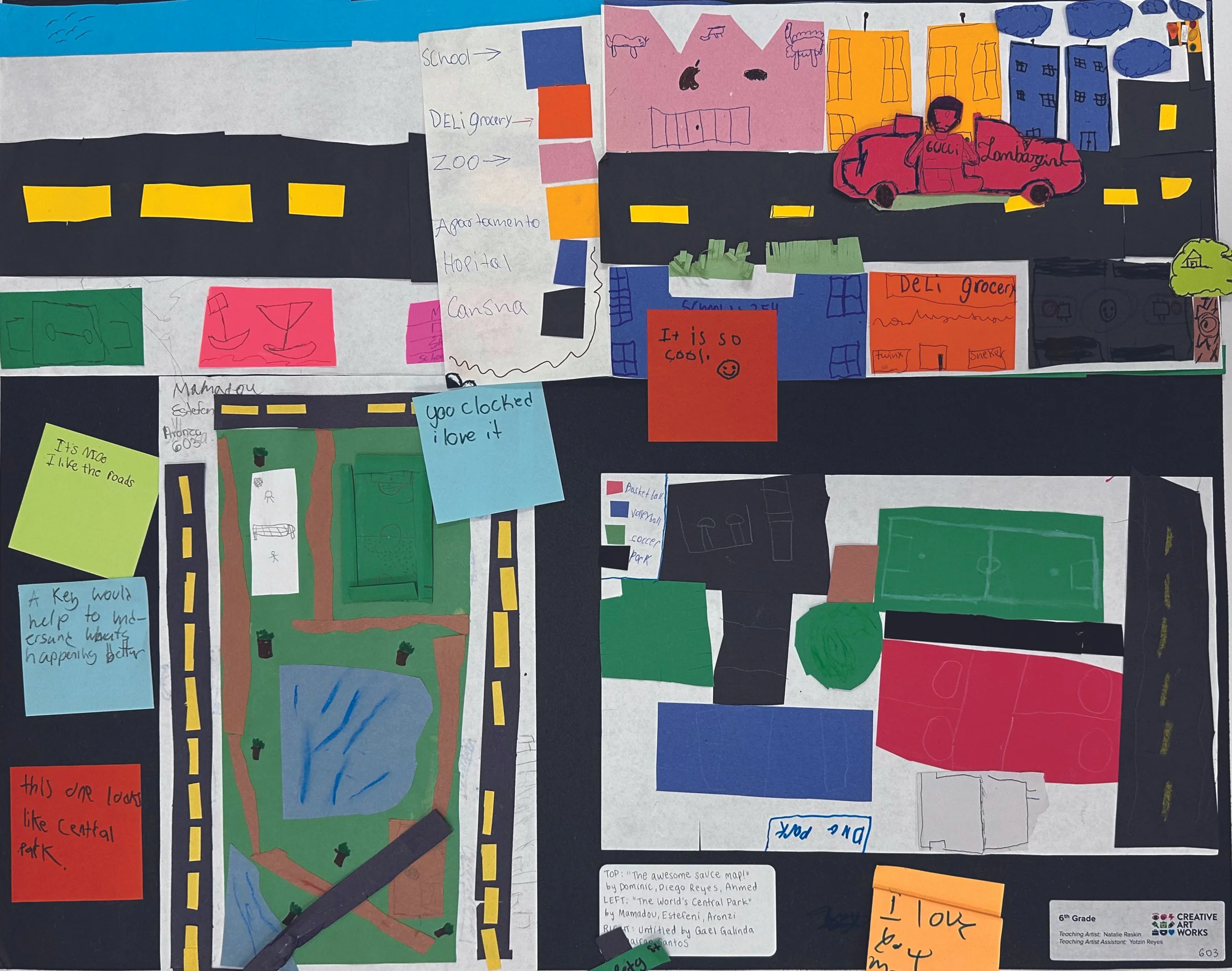
Mapping the Familier: At IS 254, Creative Art Works offers an art program that integrates with the school’s sixth-grade social studies curriculum. Following a geography unit, CAW teaching artists introduced students to diverse ways humans represent places. Students were then challenged to create maps of their own neighborhood in order to better understand the art and science of mapmaking.
Constructive Feedback: Culminating events are an essential part of all CAW curricula, as articulating their creative process to others helps students deepen their understanding of their own work. What’s more, these celebrations allow the school community to provide positive feedback, validating their artistic accomplishments and fostering a lasting sense of pride.
Forms Meets Function: Interns in an after-school workplace challenge at Manhattan Early College School for Marketing and Media Arts designed neighborhood maps that reflect their favorite hangouts around the school, including a basketball-themed guide to local courts.
Collaboration: The picture book “A Color of His Own,” by Leo Lionni, teaches the importance of friendship and community. After reading the book, students in the CAW art program at PS 368 collaborated on a giant work of art.
Nocturnal Skylines: In “Tar Beach,” written and illustrated by Faith Ringgold, Cassie Louise Lightfoot dreams of flying over the city. After reading this Caldecott-winning book, students at PS 153 created nocturnal cityscapes of their own neighborhoods using tempera paint on black paper and a lot of imagination.
How do I envision new possibilities?
It’s our perspective that robust creative experiences are essential. Our greatest aspiration is to help NYC youth access these experiences and develop the skills, agency, and self-efficacy to imagine and create new ways of being. CAW prepares young people to envision the unseen—from the abstract or surreal to concrete solutions for the complex problems they inherit in the world. With change as the only constant, they will need creativity and grit to forge pathways that don’t yet exist and may exceed their wildest expectations.
Artmaking is a generative process, a playground for radical imagination that provides the framework to visualize what does not yet exist—be it a solution to a complex social problem, an invention that changes lives, or a fantasy world brought to life through colorful characters and exotic environments.
Signal to Noise: In a three-day intensive, students at City-as-School became rapid-response designers, creating social justice posters with immediate impact. By mastering typography, color, and composition, these young designers explored how visual language can persuade or provoke, turning graphic design into a powerful tool for communication.
Envisioning a Better World (through video games): Interns in the Character Design and Advanced Illustration & Worldbuilding program address socially engaged themes—hunger, traffic safety, or environmental defense—to envision a better society through cohesive visual storytelling.
Beyond the Fold: At Innovations Diploma Plus High School, students elevated the Exquisite Corpse game by developing collaborative sketches into detailed, full-body illustrations. By placing these characters into surrealist collage environments, they transformed the randomness of a party game into cohesive worldbuilding, proving that within our subconscious lie the blueprints for entirely new realities.
Unfolding the Unconscious: Exquisite Corpse is a Surrealist game where players draw sections of a body on a folded sheet of paper without seeing the previous contributions. By prioritizing group creation over individual authorship, the game unlocks the subconscious to produce, nonsensical, and often humorous results.
Our programs nurture the creative, intellectual, and social development of young people from early reading comprehension through their first part-time job to career readiness. By following the creative process, they ultimately reshape their future.
Take a deep dive into our youth perspectives by checking out our program blogs.
Confronting the Fears that Keep Us Up at Night: Drawing inspiration from icons like Godzilla and Frankenstein, Hudson High School students designed monsters that embody contemporary anxieties. By pairing these creatures with original heroes, students explored the power of visual storytelling to confront modern fears and imagine a way to overcome them.
CAW Staff
Riki Sabel
Senior Manager of Teaching & Learning
EJ Meehan
Finance & Administration Coordinator
Emilio Vides-Curnen
Operations Coordinator
Madeline De León
Program Coordinator
Paola Gonzalez
Development & Communications Coordinator
Ivory Nunez-Medrano
Community Artmaking Initiatives Coordinator
Karen Jolicoeur
Executive Director
Ian Newton
Director of Finance & Administration
Clair Vogel
Development Manager
Scott Lucas
Manager of Marketing & Communications
Kevin Claiborne
Program Manager
Donna Manganello
Senior Program Manager
Click here to see the full list of generous sponsors and supporters that make these programs possible.